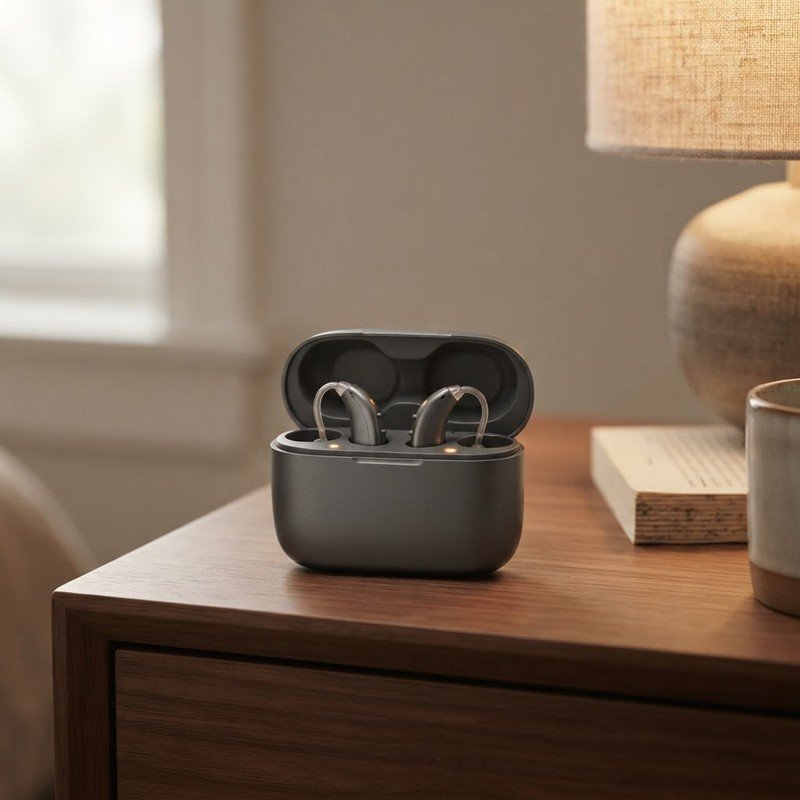
Rechargeable Hearing Aids
Charge overnight, hear all day. No more fumbling with tiny batteries — modern rechargeable technology makes hearing aids easier to live with.
Charge overnight, hear all day. No more fumbling with tiny batteries — modern rechargeable technology makes hearing aids easier to live with.
Rechargeable hearing aids have become the most popular choice for new hearing aid wearers — and it’s easy to see why. You place them in the charging case at night, and by morning they’re ready for a full day of use. No batteries to buy, no tiny compartments to open, no wondering if you have spares in your bag.
Today’s rechargeable models use lithium-ion technology, the same type used in smartphones, for reliable all-day performance. Most deliver 18–24 hours on a single charge, even with Bluetooth streaming. Some cases also act as portable power banks, giving you an extra charge on the go.
We carry rechargeable models from the leading brands — Phonak, Oticon, Starkey, Widex, ReSound, and Signia — and we’ll help you find the right fit for your lifestyle and hearing profile.
Rechargeable technology removes the biggest friction points of traditional battery-powered hearing aids.
Most rechargeable hearing aids deliver 18–24 hours of use per charge — enough for even long, active days, including hours of Bluetooth audio streaming.
Place them in the case before bed, and they’re fully charged by morning. There’s nothing to remember, no batteries to swap, and no routine to build around it.
Avoid the ongoing cost and hassle of buying size 10 or 312 batteries every week or two. Rechargeable hearing aids eliminate that entirely.
Disposable hearing aid batteries are tiny — about the size of a shirt button. Rechargeable models skip the battery door entirely, making them much easier to use for people with limited finger dexterity or vision.
Many models support fast charging — 30 minutes in the case can provide several hours of use, so a quick top-up before an event is all you need.
A pair of hearing aids can go through hundreds of disposable batteries per year. Switching to rechargeable significantly reduces that waste.
Rechargeable models suit most people — but they’re an especially strong fit for a few specific situations.
Opening a battery door and handling a 5mm battery is one of the most common frustrations with traditional hearing aids. Rechargeable models remove that challenge entirely.
If you’re frequently on the go, sweating, or outdoors, you don’t want to worry about battery life mid-hike. Rechargeable models with IP-rated water resistance are built for that.
Streaming audio from a phone or TV drains disposable batteries faster. Lithium-ion rechargeable cells handle streaming hours much better and still deliver a full day’s use.
When you’re away from home, you don’t want to track down the right battery size in an unfamiliar place. Rechargeables need only a USB-C outlet — easy anywhere in the world.
New wearers already have plenty to adjust to. Rechargeable models simplify the daily routine and let you focus on adjusting to better hearing rather than battery management.
Most people simply prefer not to deal with batteries. If that sounds like you, a rechargeable model is probably the right choice — and it’s what most of our patients choose.
We start with a full hearing assessment to understand your hearing profile. The right technology depends on your degree and type of hearing loss — not just your preference for rechargeable.
We’ll recommend rechargeable models from our brand lineup that match your hearing loss, lifestyle, and budget. All major brands now offer strong rechargeable options across price tiers.
Your hearing aids are programmed to your audiogram and verified with real-ear measurements — the clinical standard for confirming you’re hearing speech clearly, not just assuming you are.
We walk you through the charging case, how to place the aids correctly, what the indicator lights mean, and how to use fast charge if your model supports it.